
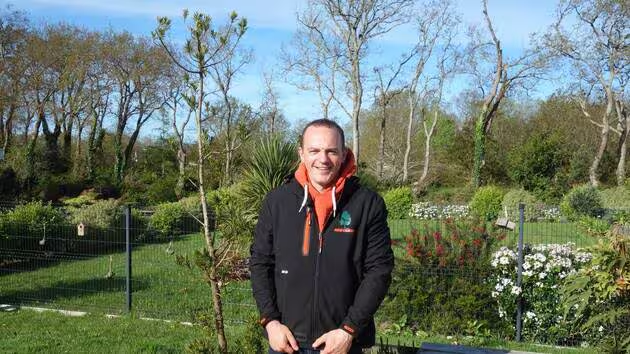
Maxime Caradec, climbing arborist in South Finistère
Maxime Caradec is a climbing arborist and the founder of Arb'Ouest, based in Fouesnant. Originally from the town, he trained for the trade in 2014 and has twelve years of practice. Before setting up Arb'Ouest in 2024, he worked for several tree-care firms. He holds the CS TSA (French national specialist certificate in tree pruning and care, 2014).
- CS TSA, tree pruning and care
- Diploma obtained in 2014
- 65 Hent Du, 29170 Fouesnant
His background
Maxime Caradec comes from Fouesnant. He knew the trees of this area before he ever pruned them, because he grew up among them. That is a more useful working asset than it seems on a coast where salt, the west wind and sandy soils dictate how a tree grows and how it breaks.
He obtained his CS TSA, the French national specialist certificate in tree pruning and care, in 2014. He then climbed for several tree-care firms, which gave him access to jobs, methods and safety standards that differ from one firm to the next. A climber who has only known one firm repeats that firm's habits, good or bad. Seeing several ways of working is what allows you to choose your own.
Arb'Ouest was registered on 23 February 2024, in Fouesnant. The launch of the business was reported two months later by Ouest-France, on 17 April 2024, then by Le Télégramme, on 20 April 2024.
Maxime Caradec works alone and brings in extra help when a job calls for it: a dismantling above a roof, a heavy removal. That is also why the schedule fills up: work is booked within fifteen days in the low season, and within a month from December to February.
Arb'Ouest works from Fouesnant across the whole of South Finistère. The towns covered are listed on the Arb'Ouest home page.
What the CS TSA changes for you
The CS TSA, the French national specialist certificate in tree pruning and care, is the French diploma of the arborist's trade. As the profession is not regulated in France, anyone can call themselves a tree surgeon, buy a chainsaw and charge for a job. For a private client, the certificate is therefore one of the few things that can be checked before signing.
A client does not see a diploma. They see a cut, and they see it for the next twenty years. A branch is cut flush with its collar, the ridge of wood that marks where it joins the trunk and that holds the tissue able to close the wound. Cutting into this collar removes that ability. Leaving a stub makes it useless, because the stub dies and the decay works its way down to the trunk. Either way the wound stays open, and a tree does not heal like skin: it compartmentalises, meaning it walls off the damaged area without ever repairing it.
Maxime Caradec's training also covers access to the tree. Rope work and dismantling with a lowering line, where each section is lowered under control rather than dropped, are what make it possible to work above a roof, a conservatory or a fence without breaking what lies below. It is slower than felling in one piece, and it is why two quotes can differ twofold without covering the same job.
Finally, it covers what must not be done. Topping, which means cutting off the top of the tree at an arbitrary height, is still commonly offered. It produces numerous, poorly anchored shoots that grow back faster and break more easily than the branches removed. A topped tree becomes dangerous again within a few years, and the job has to be done again.
Sound professional practice
Maxime Caradec holds the CS TSA (French national specialist certificate in tree pruning and care, 2014), the national diploma of the climbing arborist.
Sympathetic pruning, and why he practises it
Sympathetic pruning starts from the tree, not from the shape decided for it. It means reading the tree's structure, its health and its surroundings, then removing only what is necessary: dead wood, branches that rub, those that threaten a roof or a path. The natural outline is kept, and the area of open wounds stays as small as possible.
The reason is physiological. The leaves build up the tree's reserves. Severe pruning removes a large share of them in one go, and the tree reacts to that loss by producing vigorous shoots, attached at the surface of the wood and therefore poorly held. The tree looks under control the first year, then grows back denser and more fragile than before the work.
Sympathetic pruning takes more thinking time at the foot of the tree, and often several spaced-out visits rather than a single drastic one. It costs less over the life of the tree, because it does not set off the endless cycle of cutting back that topping imposes.
The method is described in detail on the tree pruning page. When there is a doubt about a tree's soundness or health, the pruning is preceded by a tree health and safety assessment.
What he sees in South Finistère
The tree heritage of South Finistère is changing, and changing fast. Maxime Caradec sees tree diseases spreading, which he links to global warming and to urban growth. A tree weakened by drier summers, by compacted soil or by a shrinking space at its foot withstands less well what it used to cope with.
At the same time, he sees invasive species advancing. The Asian hornet settles in tree crowns, which raises a safety question before it even raises a health one: a nest found during a climb stops the job. The processionary caterpillar, for its part, is no longer confined to pines and now colonises cedars and gorse, two plants found everywhere on this coast. Its stinging hairs are dangerous to people and to animals, which rules out treating a nest yourself.
These two findings shape the work. They explain why the assessment comes before the job rather than after it, and why biological pest control is preferred to synthetic products in gardens where children and animals live.
Tell Maxime about your tree
Describe the tree and its surroundings, or simply send a photo on WhatsApp. The reply comes with no obligation.
Quote request
After a site visit. Maxime replies in writing, by WhatsApp or email.
Before getting in touch, see what sets the price of tree pruning.