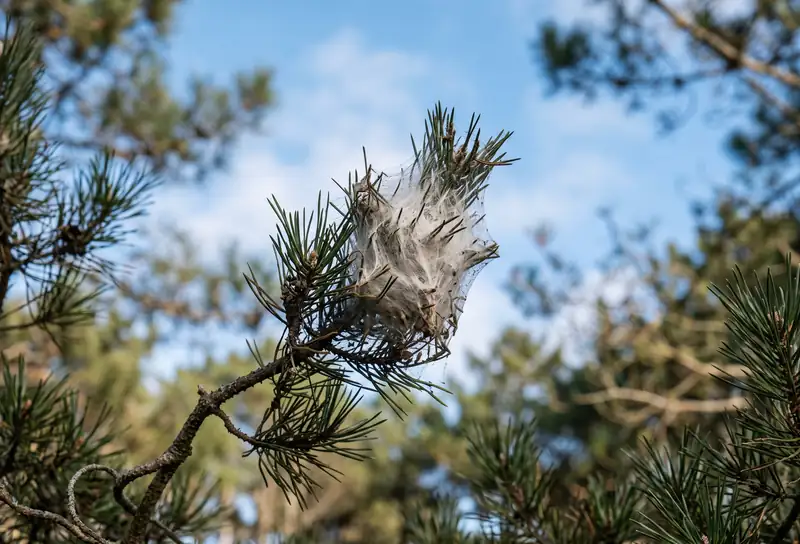
Illustration: Processionary caterpillar treatment
    Autumn and winterSouth Finistère

    Processionary caterpillar treatmentThe method depends on the season

    A white silk nest at the tip of a branch, a line of caterpillars crossing the drive: the problem does not go away on its own, and it comes back stronger the following year. We work on the pines of the Fouesnant area.

    Climbing arborist

    French national specialist certificate in tree pruning and care, 2014

    4.9/5 from 38 Google reviews, as of 15 October 2026

    As of 15 October 2026

    Quote after a site visit

    South Finistère

    Local service

    Our processionary caterpillar treatment services

    Professional services tailored to your needs

    Finding the nest

    A white silk pouch at the tip of a branch, on a pine or a cedar. A photo is often enough to confirm it.

    Collar eco-trap

    A sealed collar around the trunk catches the caterpillars on their way down and sends them into a collection bag. Fitted in winter.

    Bacillus thuringiensis

    A soil bacterium that the caterpillar swallows as it feeds. Sprayed in autumn.

    Pheromone trap

    Set in summer, it catches the male moths and reduces the nests of the following winter.

    Nest boxes for tits

    The great tit eats the caterpillars without minding the hairs. Long-term prevention.

    Removal by the climber

    When the nest can be reached on ropes. Whether it is feasible is judged on site.

    Safety: the concrete answer

    Should you remove a processionary caterpillar nest yourself?

    No. Hosed down, burnt or shot down, a nest scatters its stinging hairs over the whole property, where they stay active for years. Maxime Caradec, the climbing arborist of Arb'Ouest, reaches it on ropes.

    Why a processionary caterpillar is dangerous

    At the slightest disturbance, each caterpillar releases thousands of microscopic stinging hairs: itching and eye injuries in people, necrosis of the tongue in dogs. A nest that fell two years ago is still stinging.

    The dog is the most frequent victim: it sniffs the line of caterpillars, then licks it. It is a veterinary emergency. The risk peaks from late winter into spring, during the processions.

    What not to do yourself

    A hose blasts the nest apart and drops the hairs on the lawn and on you. Burning makes them breathable. A shotgun spreads them where the children play. Cutting the branch without protection leaves an intact nest on the ground that will still have to be picked up.

    Which method to choose

    With a dog or children, the eco-trap. It is the only method that physically stops the caterpillars from reaching the ground.

    Bacillus thuringiensis is only worth using in autumn: once winter has passed, the caterpillars eat less and it loses its point. The pheromone trap has no effect on a nest already in place: it prepares the following year.

    Why use a climbing arborist rather than treat it yourself?

    Reaching the nest on ropes

    The nest sits at the tip of a branch, several metres off the ground.

    Harmless to animals

    Bt does not act on dogs, birds or pollinators.

    A tightly sealed trap

    On the furrowed bark of a maritime pine, everything depends on it.

    The right season

    Out of season, you are told so, even if it means waiting for autumn.

    A qualified climbing arborist

    Maxime Caradec holds the CS TSA (French national specialist certificate in tree pruning and care, 2014).

    Quote after a site visit

    • No commitment

      Compare freely

    • Transparent pricing

      No surprises

    • Storm emergencies

      Handled 7 days a week

    • Cleanup included

      The garden is left clean

    Request a quote

    Frequently asked questions about processionary caterpillar treatment

    Everything you need to know before contacting us

    There is a processionary caterpillar nest in my pine. What should I do?

    +

    Do not touch it, and keep children and dogs away from the tree. Send us a photo taken from a distance. Depending on the season, an eco-trap is fitted in winter or the tree is treated with Bacillus thuringiensis in autumn.

    How much does processionary caterpillar treatment cost?

    +

    The eco-trap and Bacillus thuringiensis are both priced on a quote, according to the size and number of trees, after a site visit within 30 km of Fouesnant.

    When should the treatment be done?

    +

    Bacillus thuringiensis in autumn, while the young colonies are feeding. The eco-trap in winter, before the processions. The pheromone trap in summer. Nests are spotted in winter and treated the following autumn.

    My dog has licked a processionary caterpillar. What should I do?

    +

    Call a vet immediately: it is an emergency counted in minutes. Our part comes afterwards: finding the pine the caterpillar came from, which can almost always be seen from the property.

    Is treatment compulsory?

    +

    The pine processionary caterpillar is classed as harmful to human health, and many towns make control compulsory by local order. The rules vary across South Finistère: your town hall (mairie) will tell you what applies.

    What our clients say

    Verified reviews from our Google Business listing

    Customer reviews, on Google

    No review is copied onto this site. They can all be read at their source, on the Google profile of Arb'Ouest. The reviews themselves are written in French.

    4.9/ 5

    38 reviews on Google Business Profile

    As of 15 October 2026.

    Read the 38 reviews on Google

    Request a quote for processionary caterpillar treatment

    Describe the tree in two lines. The quote is sent within 72 hours of the visit. Allow a week from December to February.

    Quote request

    After a site visit. Maxime replies in writing, by WhatsApp or email.

    Quote written after a site visit, with no obligation.

    What makes the price? What sets the price of tree pruning

    Need help with processionary caterpillar treatment?

    Send a photo of the tree on WhatsApp. The quote follows a site visit, with no obligation.