
Tree surgeon or arborist: what is the difference, and who to call?
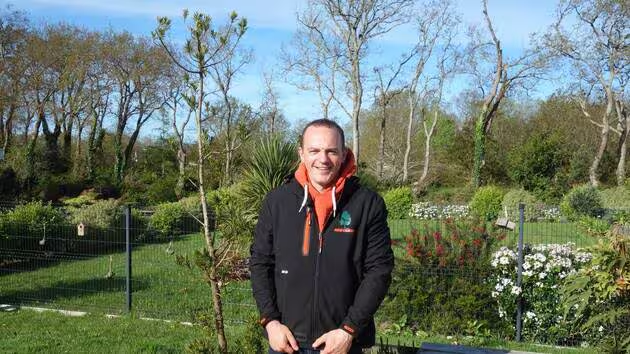
Maxime Caradec
Climbing arborist
CS TSA (French national specialist certificate in tree pruning and care, 2014)
Contents
Tree surgeon or arborist: the short answer
In France, the two words usually describe the same trade, and neither is protected by law. What separates them in practice is the diploma: “arborist” implies training in the care of living trees, which in France means the CS TSA, the national specialist certificate in tree pruning and care. Without that diploma, anyone can call themselves a tree surgeon tomorrow.
Do the two words describe the same person?
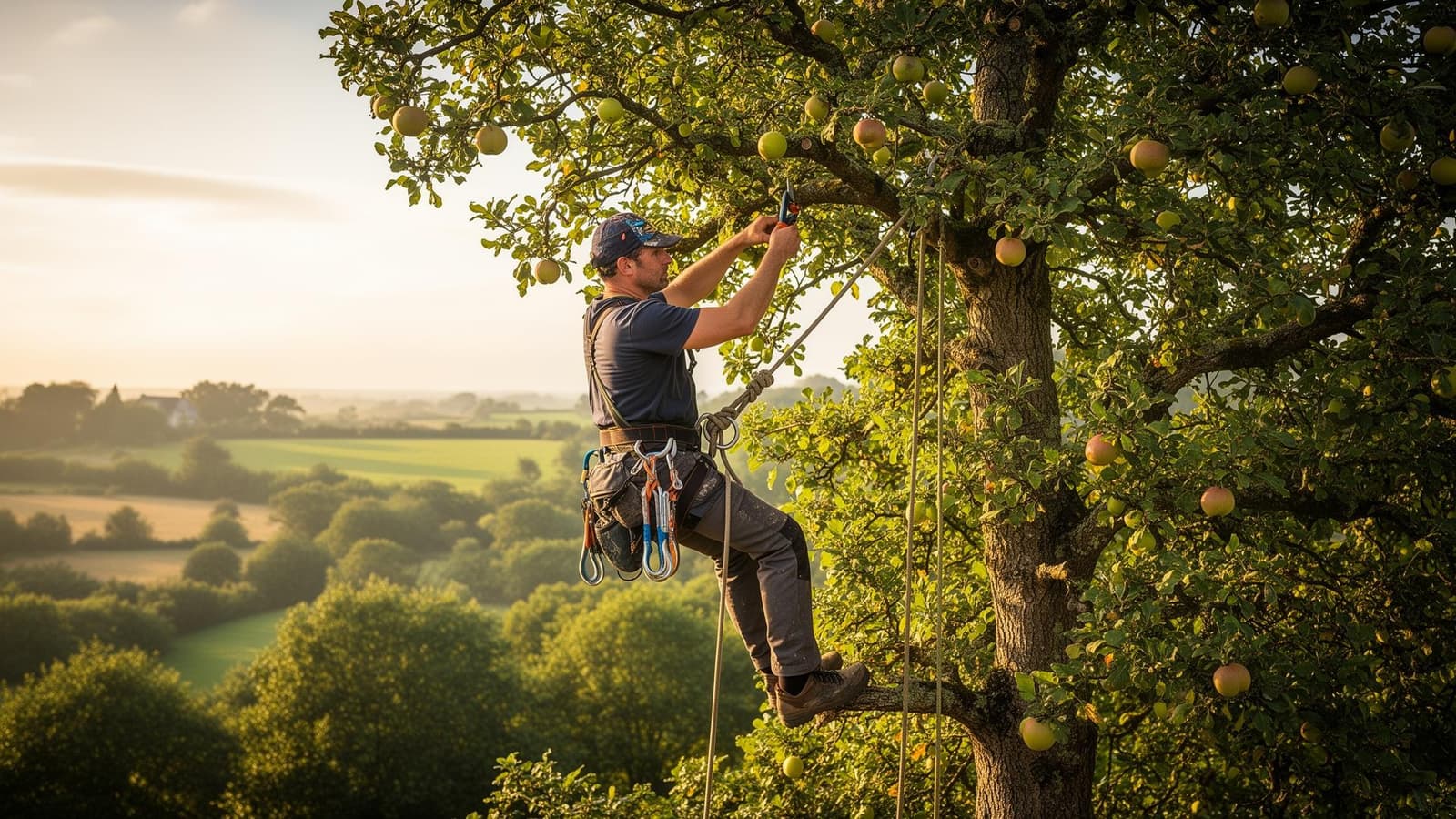
In everyday practice, yes, and the vocabulary is loose. “Tree surgeon” describes an act, cutting branches. “Arborist” describes what is worked on, the tree and its health. “Climbing arborist” specifies the means of access, on ropes.
The distinction that matters is not about language. None of these titles is reserved to the holders of a diploma, unlike those of architect or chartered accountant: nobody checks who uses them on a business card or in an advert. A quote is therefore not worth the word chosen for its heading, but what can be checked behind it.
One family of words does deserve to be told apart: fruit growing, which produces fruit, is not the same trade as ornamental arboriculture, which cares for garden and street trees. The first sells apples, the second climbs trees.
What does the CS TSA cover?
The CS TSA is a specialisation certificate from the French Ministry of Agriculture, taken after a first diploma in landscaping or forestry. It is the reference diploma of the trade in France. Maxime Caradec, founder of Arb'Ouest, holds the CS TSA (French national specialist certificate in tree pruning and care, 2014).
What it brings comes down to four things, all visible on a job. Tree biology first: understanding that a tree does not heal but walls off the wounded area, and that pruning is adjusted to that mechanism. Diagnosis next: reading a weak anchorage, a fork with included bark, a fungus at the root collar. Then the position of the cut, which decides whether the wound closes or leaves a door open. And finally work at height: rope, harness and controlled lowering of sections.
What an arborist does not do
The question of scope is as useful as the question of the diploma, because a contractor who accepts everything is rarely trained for everything.
Arb'Ouest does not destroy Asian hornet nests: that work falls under pest control. Nor does it practise topping, the cut that removes the top of a mature tree, and that refusal is constant. Finally, it does not produce court expert reports: a written assessment states what is observed on the tree, it does not settle a dispute.
When is a gardener enough?
Often, and there is no reason to call an arborist for everything. A laurel or privet hedge trimmed from the ground, a border to maintain, mowing, a young two-metre fruit tree: that is work for a gardener or a landscaper, and all the better for the budget.
The tipping point comes down to one simple question: is the work done with both feet on the ground, with a garden tool? If the answer is yes, a gardener is enough. As soon as someone has to climb, cut large-diameter wood with a chainsaw or decide what to remove from a mature tree, it becomes a different trade, with a different risk.
When do you need an arborist?
Four situations, which come up every week across the area Arb'Ouest covers.
The tree is tall or close to a building, and the wood cannot simply drop: it has to be lowered in sections held on a rope. You wonder whether it is dangerous, and that is for an assessment to answer, not a hunch formed from the window. You want to reduce its height without condemning it, which means taking each cut back to a branch that can take over. Or the tree shows worrying signs: a fungus at the base, bark coming away, dead wood in the crown.
In South Finistère, a fifth reason comes round every winter: a branch left hanging after a gale. That one cannot be dealt with from the ground or from a ladder.
How to check before signing?
Four checks, which take ten minutes from a phone.
- The diploma: ask which one, and in what year. The CS TSA has a precise name; a vague answer says a lot.
- The insurance: ask for the professional liability policy number. Arb'Ouest is covered by AXA, policy no. 0300011220841434.
- The registration: a registered business can be looked up in the public registers. Arb'Ouest has been registered since 23 February 2024.
- The written quote: it specifies the work, the height, what is taken away and what stays on site. At Arb'Ouest, it is drawn up after a site visit, travel and removal included.
A fifth signal is not asked for, it is heard: a contractor who suggests cutting the top off the tree to solve a height problem has just answered the question about the diploma.
Maxime Caradec was born in Fouesnant, has worked in the trade for twelve years and founded Arb'Ouest in 2024. The business was featured in Ouest-France on 17 April 2024 and in Le Télégramme on 20 April 2024. Its Google profile is rated 4.9/5 from 38 reviews, as of 15 October 2026.
Further reading
The background, diploma and work of Maxime Caradec, climbing arborist in South Finistère are set out on his page.
Unsure about the condition of a tree?
Arb'Ouest works within 30 km of Fouesnant. Maxime Caradec runs the business. He holds the following diploma:
CS TSA (French national specialist certificate in tree pruning and care, 2014).